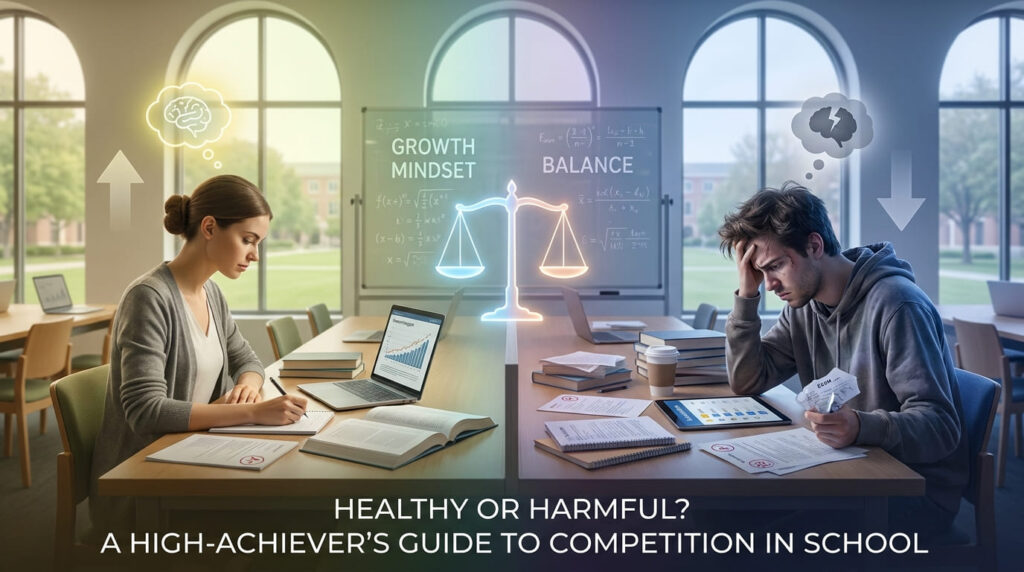
For many high-achievers, maybe all of them, competition is simply part of the deal. The moment you start reaching for your full potential, you tend to find yourself surrounded by other people doing the same thing. In student life, as everywhere else, competitiveness shows up in many forms. Some of it is harmless, even genuinely good for you. Some of it is far more draining. And every student responds to it differently. This guide from Synap Science breaks it down so you can figure out where you stand.
Competition Isn’t Automatically Good or Bad
Before anything else, it helps to clear away a couple of stereotypes. A highly competitive school is often labeled “unfriendly” or even “toxic.” A more relaxed school gets caricatured as less rigorous or less ambitious. Neither idea always holds true.
For some students, a calmer setting is exactly right, a place to pursue their passions without the constant circus of grade rankings and awards. For others, a classroom buzzing with friendly rivalry pushes them to heights they never would have reached alone. There is no single “correct” amount of competition. What matters is how a given environment fits you.
You Rarely Get to Choose Your Environment
Here’s the reality for nearly every student: you have very few chances to actually choose the level of competition around you. Transferring schools is a complex, uncertain process. And even within one school, the culture can vary widely from class to class and teacher to teacher.
Since you can’t always control the water you’re swimming in, the next best thing is to assess it honestly. Pay attention to the type and intensity of competition surrounding you, and notice how it lands. Awareness is the first real tool you have.
Check In With How School Makes You Feel
One simple way to assess your environment is to examine the emotions you attach to school. At Synap Science, we encourage students to start with a quick mental check-in.
Do you walk into English class genuinely eager to share your interpretation of the reading? Do you head into the chemistry lab actually curious to collect the cleanest, most accurate data you can? Or are you chasing perfection mostly out of a fear of embarrassment, afraid of looking less capable than the person beside you?
That distinction matters enormously. Competition rooted in curiosity and pride in your work tends to energize you. Competition rooted in fear tends to quietly wear you down. One of the most effective ways to manage the stress of a competitive environment is to deliberately refocus on the joy in the work itself, the puzzle, the discovery, the progress, rather than the scoreboard around it.
When Competition Spills Beyond the Classroom
Competition doesn’t stay neatly inside academics. As you move through your adolescent and teen years, sports and extracurricular activities get more serious and more competitive, too. That isn’t a bad thing on its own, but it’s worth watching closely.
Competitiveness can quietly blind you to how much time and energy you’re pouring into something. Healthy competition has its place, but unless an activity is a genuine part of your long-term plan, chasing first chair in the orchestra or a spot in the starting lineup should never crowd out your studies or your time with family. Those things matter more, even when the immediate pressure makes them feel smaller.
A useful habit is to regularly weigh the competition you’re in against your own actual goals. If they line up, great. If they don’t, that’s a signal to recalibrate.
The Trickiest Kind: Social Competition
The hardest competition to spot is the kind that creeps into nebulous social situations. In its worst forms, you might find yourself competing over appearance, popularity, or being “in” with the right crowd.
It’s usually not worth it. Friendships and your social life are meant to give you energy and joy. If those relationships are mostly producing stress, comparison, and anxiety, they aren’t doing what they’re supposed to do. Recognizing that can be uncomfortable, but naming it honestly is the first step toward changing it.
Finding Your Balance
There’s no formula here, and no environment will ever be perfectly tuned to you. The goal isn’t to eliminate competition; it’s to find a balance where the exciting, motivating kind has room to push you forward, and the draining kind doesn’t quietly take over your life.
That balance takes attention, honesty, and time. It can feel awkward at first to question habits you’ve held for years. But with steady effort, you can build a relationship with competition that supports your goals instead of running them.
At Synap Science, we believe self-awareness is the foundation of a healthy, sustainable student life. If competitive pressure has started to feel heavier than it should, the self-help resources at Synap Science, covering stress coping, emotion regulation, and challenging negative thoughts, can help you find your footing again. Competition will always be part of being a high achiever, but with the right tools and the right mindset, it can become a source of growth rather than a source of dread.
Frequently Asked Questions
How do I know if competition is healthy or unhealthy for me?
Notice the emotion behind it. Competition driven by curiosity, pride, and genuine interest usually energizes you. Competition driven by fear of embarrassment or failure tends to drain you over time.
Is a competitive school better than a relaxed one?
Neither is universally better. Some students thrive on lively rivalry; others do their best work in a calmer setting. What matters is how well the environment fits your personality and goals.
What should I do if competition is hurting my grades or family time?
Weigh the activity against your real long-term goals. Unless it’s central to your plans, it shouldn’t override your studies or time with family. Scaling back isn’t failure; it’s smart prioritizing.
How do I handle competition in friendships and social life?
If a relationship mostly produces stress and comparison rather than joy and support, that’s a sign that something is off. Social connections should give you energy, not take it. Synap Science offers self-help tools on healthy communication and emotion regulation that can help.